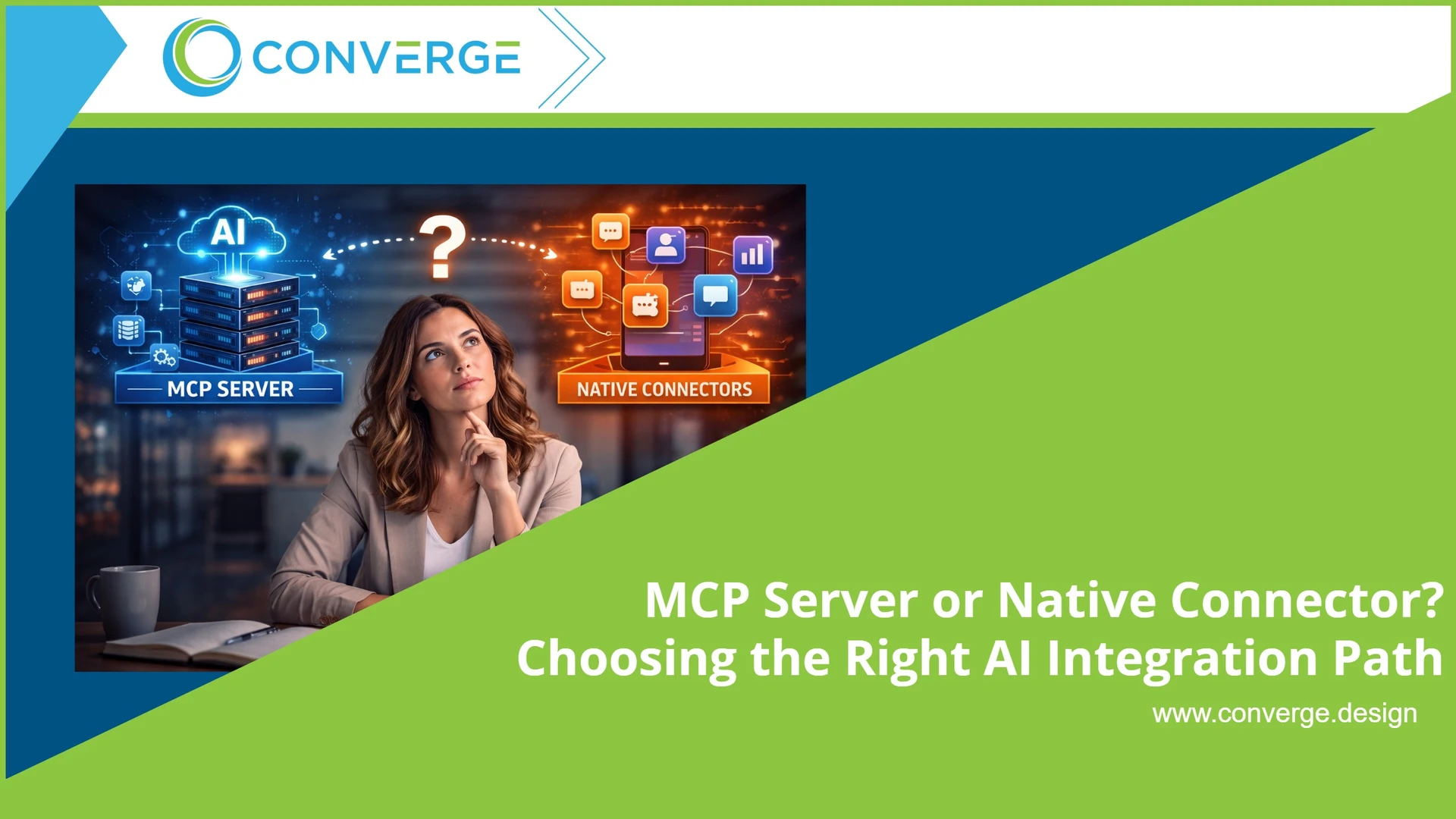
As AI becomes more practical inside engineering and business workflows, companies are facing a new integration decision: build and deploy your own MCP server, or rely on native in-app connectors.
An MCP (Model Context Protocol) server acts as a bridge between AI models and external tools, data sources, or applications. It standardizes how models request and receive contextual information—such as files, databases, APIs, or user-specific data—so they can produce more accurate and relevant responses. Instead of hardcoding integrations, an MCP server allows different systems to plug into a common interface, making it easier to scale, secure, and manage how AI interacts with real-world data and services.
 A self-managed MCP server gives organizations more control. It can standardize how AI tools access internal systems, apply custom permissions, and support unique workflows across platforms. For teams with complex environments, that flexibility matters. It also aligns with the growing need for role-based access, stronger data governance, and infrastructure choices that fit sensitive or hybrid deployments. The downside is the added lift. Building, securing, maintaining, and updating your own MCP layer requires time, technical oversight, and a clear operating model.
Native in-app connectors offer speed and simplicity. They are easier to deploy, faster to test, and ideal for organizations that want immediate value without adding another system to manage. But that convenience can come with tradeoffs. Native connectors may be limited by vendor rules, narrower customization, and less control over how data, permissions, and workflows are handled across the broader environment. 
At Converge, we see this as a familiar challenge: balancing flexibility with operational simplicity. Our broader AI positioning already reflects that need to bring AI into real workflows without disrupting them .
Looking ahead, both options will remain relevant. Native connectors will get better, faster, and more secure. MCP servers will become more valuable for companies that need interoperability, governance, and orchestration across many tools. The future likely is not either-or. It is a hybrid model where native connectors handle quick wins, while MCP infrastructure powers scalable, business-specific AI ecosystems.