 For many engineering firms, intellectual property does not live in a patent filing or a legal binder. It lives in CAD assemblies, PDM vaults, revision histories, simulation results, drawings, ECNs, and the tribal knowledge encoded in product data. That means a single infrastructure failure can become far more than an IT issue. It can delay release schedules, disrupt customer commitments, and force teams to recreate work they already completed.
Picture a product development team arriving Monday morning to find their on-prem server offline. Maybe a storage controller failed over the weekend. Maybe a ransomware variant encrypted file shares and locked access to the PDM database. Either way, engineers cannot check files in or out, drawings are unavailable to manufacturing, and everyone is asking the same question: how quickly can we recover, and what did we lose?
That is why protecting IP has to be proactive, not reactive. For small-to-medium engineering and manufacturing firms, the real risk is rarely just the event itself. It is the downtime, rework, uncertainty, and business disruption that follow. Cloud hosting, when designed correctly, shifts security from a patchwork of manual safeguards to a more resilient operating model built to protect engineering data before failure happens.
The Two Threats — Hardware Failure and Ransomware
Hardware failure remains one of the most underestimated threats to engineering data. Servers age. Drives fail. RAID arrays degrade. Controllers malfunction. Power events and cooling issues can corrupt storage or take systems offline without warning. In engineering environments, the impact is amplified because design data is interdependent. Lose access to a vault, database, or file archive, and you may interrupt not just one user’s work, but an entire release process. CAD files can become unavailable, PDM references can break, and teams may spend days validating which versions are current and complete.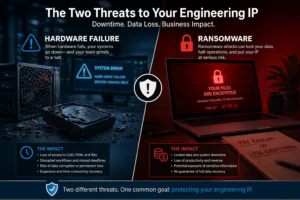
Ransomware is different, but the operational outcome is often similar: lost access, halted work, and pressure to recover quickly. Modern ransomware does not simply encrypt a few endpoints. It targets shared storage, administrative accounts, backup repositories, and infrastructure management tools. For engineering teams, that can mean encrypted vault files, compromised drawing libraries, inaccessible revision histories, and production delays while systems are investigated and restored.
In both cases, the real damage is not only data loss. It is downtime, broken workflows, forced rebuilds, missed deadlines, and reduced confidence in the integrity of your product data.
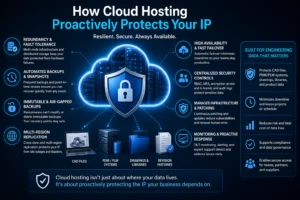
How Cloud Hosting Proactively Protects Your IP
The strongest case for cloud hosting is not convenience. It is resilience by design.
A well-architected hosted environment reduces dependence on any single piece of hardware. Instead of relying on one physical server, one storage appliance, or one office location, cloud-hosted systems typically use redundant compute and distributed storage. That includes multi-node infrastructure, storage abstraction layers, and fault-tolerant architectures that keep services running even when individual components fail. For engineering teams, that means your CAD libraries, PDM vaults, and associated databases are less likely to disappear because one server, controller, or disk array went down.
Backups are another critical difference, but only when they are automated and designed for real recovery. Cloud hosting platforms can create scheduled backups, frequent snapshots, and point-in-time recovery options that protect both file data and system state. That matters for PDM and PLM systems because recovery is not just about restoring a folder of CAD files. You also need the database, metadata, permissions, lifecycle states, and revision relationships to be consistent. Point-in-time restore helps recover the whole environment to a known-good state, not just fragments of it.
For ransomware defense, immutable and air-gapped backups are especially important. If backup copies can be altered or deleted by the same compromised credentials used in an attack, they are not a real recovery strategy. Immutable backups prevent modification for a defined retention period. Air-gapped or logically isolated backup copies create separation from the primary environment. Together, these controls make it much harder for attackers to destroy your recovery path. That is essential when the data at risk includes years of design history, released drawings, and controlled documentation.
High availability and fast failover also change the economics of disruption. In a traditional on-prem environment, a serious hardware problem can mean waiting on replacement parts, rebuilding a server, restoring data, and manually validating system integrity. In a hosted environment with HA design, workloads can fail over to healthy infrastructure more quickly, reducing downtime from days to hours or less. For engineering and manufacturing teams, that can be the difference between a short interruption and a full production bottleneck.
Replication across zones or regions adds another layer of protection. If a host, rack, or even an entire location experiences failure, replicated data can support recovery from a separate environment. This is particularly valuable for firms that cannot tolerate a single-site dependency for product data. Your vault, drawings, and revision history should not be vulnerable to one building, one power event, or one local disaster.
Security controls also become more centralized and consistent. Role-based access control limits who can reach critical systems. MFA reduces the risk of compromised passwords. Encryption at rest and in transit protects sensitive design data whether it is stored, moved, or accessed remotely. Audit logs help identify who accessed what and when. For engineering organizations with mixed internal and external stakeholders, these controls improve governance around the very systems that contain your competitive advantage.
Equally important, managed infrastructure reduces human error. Many outages and compromises happen not because a defense was impossible, but because patching was delayed, backups were not verified, permissions expanded over time, or a configuration drifted from best practice. In a properly managed cloud environment, infrastructure maintenance, OS updates, monitoring, and alerting are handled continuously rather than sporadically. That lowers the odds that a known vulnerability or overlooked failure point becomes a crisis.
Finally, proactive monitoring and incident response help teams act before a small issue becomes a full outage. Alerts on storage health, unusual access behavior, failed jobs, and suspicious activity create earlier intervention points. In practical terms, that helps protect not only CAD files, but also the underlying PDM/PLM databases, libraries, templates, BOM-related data, and the revision history that makes engineering collaboration trustworthy.
Ransomware-Specific Controls & Recovery
Ransomware resilience requires more than “we have backups.”
A mature defense includes versioning, immutable backup copies, anomaly detection, containment controls, and tested recovery procedures. 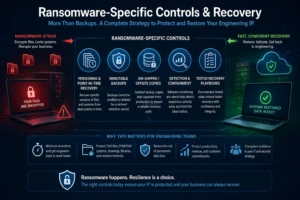 Versioning helps recover from encrypted or corrupted files without rolling back everything. Immutable backups prevent attackers from tampering with recovery points. Detection tools can flag unusual encryption activity, privilege escalation, or mass file changes before the blast radius spreads further.
Just as important, recovery playbooks must be tested. Teams need to know how to isolate affected systems, validate clean restore points, bring critical services back online in the right order, and confirm data integrity before users reconnect. Backups alone are not enough if recovery is slow, incomplete, or untested.
Practical Recommendations
- Require immutable backups for all CAD, PDM, PLM, and engineering file repositories.
- Maintain at least one offsite or air-gapped backup copy separate from production.
- Enforce least-privilege access with role-based permissions for users and admins.
- Enable MFA and, where possible, SSO for all remote and privileged access.
- Test restores at least quarterly, including full environment recovery for PDM or PLM systems.
- Choose a hosting provider with documented SLAs, audit logs, and clear incident response procedures.
- Use continuous patching, vulnerability scanning, and monitored endpoint protection.
- Replicate critical systems across zones or regions to reduce single-site risk.
Short Case Example
Consider a mid-sized engineering firm running PDM on an aging on-prem server. After a storage failure, the vault became unavailable and the team spent nearly two days restoring files, rebuilding services, and confirming which revisions were trustworthy. Months later, a ransomware event on a separate file server exposed another weakness: backups existed, but recovery was slow and validation was manual.
After moving its engineering environment to a hosted platform, the same firm operated with scheduled snapshots, immutable backups, monitored infrastructure, and a documented recovery workflow. When a suspicious encryption event later affected a user account, the incident was contained quickly, the affected data was rolled back to a clean point in time, and engineering operations resumed with far less downtime. The difference was not luck. It was architecture. 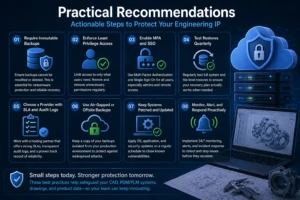
Conclusion
Cloud hosting is not just a different place to run your systems. It is a proactive security strategy for protecting the IP your business depends on. When resilience, backup integrity, access control, and recovery are built into the environment, hardware failure and ransomware become far less disruptive. To see what that looks like in practice, request a demo, download our technical checklist, or contact Converge for a security review of your CAD and PDM environment.