 For engineering teams, creating great designs is only part of the job. The real challenge often comes afterward: getting the right documents into the right hands, at the right time, without creating confusion, delays, or costly revision mistakes.
That is exactly where Flatter Files shines.
At Converge, we see Flatter Files as one of the most effective platforms available for storing and distributing the flat files that matter most to manufacturing, purchasing, suppliers, field teams, and other non-CAD stakeholders. Rather than forcing every downstream user to access SOLIDWORKS and PDM directly, Flatter Files gives organizations a better way to publish and control PDFs, STEP files, IGES files, DXF/DWG files, and other derived documents tied to engineering data. Internally, Converge positions Flatter Files as a cloud-based “digital flat file cabinet for drawing distribution” that complements PDM by making approved engineering data accessible to the people who actually need it .
Why engineering teams need more than PDM alone
SOLIDWORKS PDM is excellent for managing design files, revisions, workflows, and approvals inside the engineering environment. But most companies do not want to purchase CAD or PDM access for every vendor, machinist, buyer, assembler, or field technician who simply needs the latest released documentation.
This creates a common problem: engineering data gets shared through email, shared drives, local folders, or printed drawings. Those methods are fast in the moment, but they are difficult to control and even harder to keep current. This is a common and major customer challenge, and Flatter Files offers the most seamless solution for distributing drawings in a controlled manner instead of through uncontrolled channels.
A cloud-based publishing platform built for real-world distribution
Flatter Files is not meant to replace PDM. It is meant to extend it.
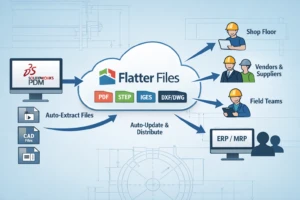
It acts as a cloud-based publishing platform that ties into your PDM vault and watches for the events that matter. When a file reaches the right point in your workflow, such as a state change or approval, Flatter Files can automatically generate the flat files your downstream teams need and publish them to the cloud. This is a seamless integration where actions in the PDM vault trigger Flatter Files to automatically generate external files like PDFs and upload them to its cloud environment, and notify all stakeholders of the updated file version. 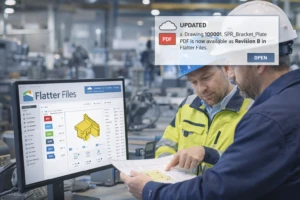
That means your engineering team is not wasting time manually creating and emailing export packages. The system handles the publishing, so stakeholders always know where to find the documents they need.
Automatic creation of the files your business actually uses
One of the biggest strengths of Flatter Files is automation.
When properly connected to your workflow, it can automatically generate the output files that downstream teams need from your CAD source data. That can include:
- PDFs for manufacturing and review
- STEP files for suppliers and partners
- IGES files for interoperability
- DXF/DWG files for fabrication and CNC-related workflows
Flatter Files gives you the ability to automatically create the necessary external files and keep those published documents connected to the original CAD content.
This turns what is often a manual, error-prone process into an automated publishing pipeline.
Revision control that protects your shop floor and supply chain
This is the feature that makes Flatter Files especially powerful.
It is not enough to publish a PDF once. The real value comes from knowing that when engineering makes a change, the old version will not continue circulating in the wild.
When a drawing changes state in the PDM vault, Flatter Files can notify recipients, make the outdated drawing unavailable, and ensure that the latest approved version is the one people access moving forward.
That is a major advantage for manufacturers, vendors, and distributed teams. Instead of wondering whether a supplier is using Revision B or Revision C, you have a controlled distribution system that helps remove uncertainty.
In practice, that means fewer bad parts, fewer rework cycles, fewer urgent emails, and fewer costly mistakes caused by outdated documentation.
Separate version control for published flat files
Another important benefit is that Flatter Files maintains version awareness for the documents it publishes.
Your engineering team can continue managing native CAD files and formal workflows in SOLIDWORKS PDM, while Flatter Files manages the published output side of the process for broader consumption.
This separation is important. Engineering retains control over the source files, while the rest of the organization gets controlled access to the latest released deliverables.
Better access for non-CAD users, vendors, and partners
Most people who need engineering documents are not CAD users. They do not need full access to SOLIDWORKS, and they certainly do not need to navigate a PDM vault just to find a PDF or a STEP file.
Flatter Files makes those documents available through a secure cloud platform for unlimited viewers, including vendors, suppliers, partners, and internal non-CAD teams . That is a much cleaner way to support collaboration across departments and external organizations.
For companies with distributed teams, contract manufacturers, or frequent supplier interaction, this becomes a practical way to extend engineering data access without expanding CAD/PDM license requirements.
A cleaner path into ERP and MRP workflows
Once Flatter Files is creating and maintaining your released documents, it also becomes much easier to move those outputs into other business systems.
For many organizations, that means ERP or MRP.
Instead of relying on someone to manually collect the latest files from a vault and pass them along, Flatter Files creates a more reliable handoff point. Engineering releases the data, Flatter Files publishes the flat files, and the downstream systems and stakeholders consume the current, approved outputs.
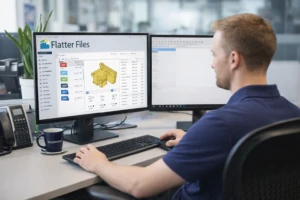 That kind of process maturity matters. It reduces administrative burden, simplifies cross-functional coordination, and helps connect engineering decisions to manufacturing execution.
Why Converge recommends Flatter Files
At Converge, we work with companies that need more than basic file storage. They need controlled engineering data distribution that fits into real workflows.
Flatter Files stands out because it helps solve a very specific and very expensive problem: how to get the right released documents to the right people without giving everyone access to CAD and PDM, and without letting outdated revisions slip through. Flatter Files is an elegant solution for controlled distribution, automated publishing, and preventing costly downstream errors.
For teams already using SOLIDWORKS PDM, it is a natural complement. For teams trying to reduce manual document handling, improve stakeholder access, and tighten revision control outside the engineering department, it can be a game changer.
Final thoughts
 If your organization still relies on manual exports, email attachments, shared folders, or paper drawings to distribute engineering documentation, you are carrying more risk than you need to.
Flatter Files gives you a better model: automated publishing from PDM, cloud-based access for stakeholders, strong revision control, and a simpler bridge to the systems that keep manufacturing moving.
For Converge, that is why Flatter Files remains one of the most compelling platforms for distributing the flat files that power modern engineering operations.