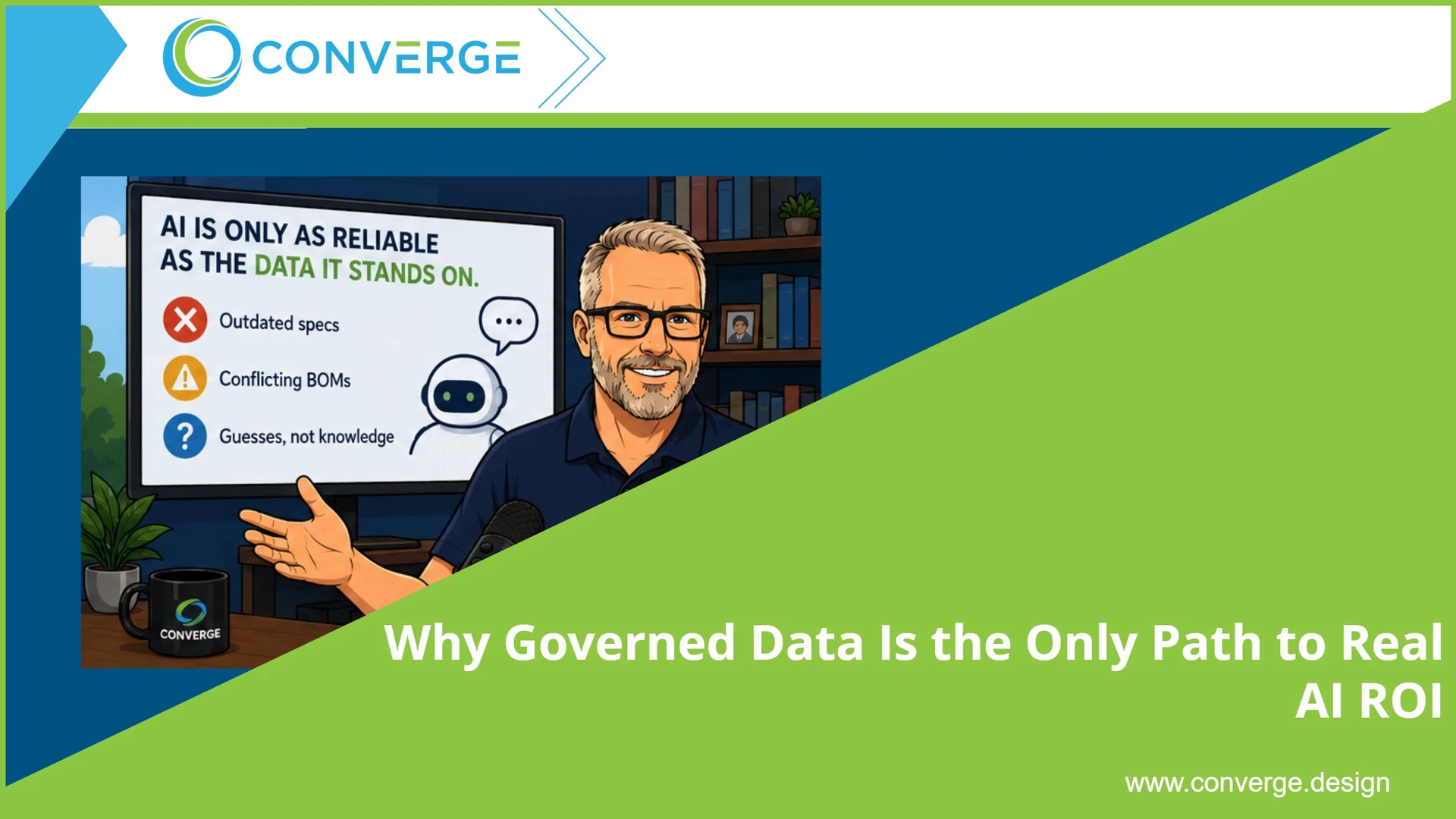
Every engineering leader is hearing the same message: adopt AI or fall behind. So teams buy a tool, point it at their files, and wait for the payoff. Then the answers come back wrong. The AI cites a specification your team superseded two years ago. It builds a quote from a bill of materials that three departments each maintain differently. It explains a manufacturing process nobody ever wrote down, filling the gap with a guess. The tool is not broken. The data underneath it is.
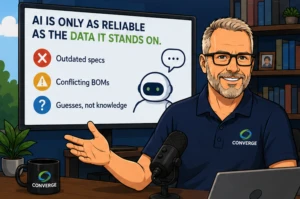 This is the part the hype skips. AI does not just fail quietly on bad data. It fails persuasively. A keyword search that finds nothing at least tells you so. An AI assistant sitting on ungoverned data returns a clean, well written, completely wrong answer, and your team acts on it. Someone builds to outdated specs. Sales quotes from conflicting BOMs. A plausible invention replaces the knowledge that once lived in one senior engineer's head. The more your team trusts the output, the more expensive the error. Ungoverned data does not just lower your AI ROI. It can turn it negative.
The lesson is one engineers already know from every other system they run. AI is only as reliable as the data and knowledge it stands on. Before it can create value, you have to organize your information, keep it current, and govern it. That is not a limitation to work around. It is the job. It is why Converge approaches every AI engagement through a framework we call Organize, Distill, Integrate.
Organize: get your knowledge under control
First you put your information in order. Scattered network drives, duplicate drawings, out of date specs, and BOMs that disagree are the raw material of a bad AI answer. We identify the data and documents that actually run your business, then bring them under one governed source of truth. For most engineering teams that means getting design data into a managed PDM (Product Data Management) environment where you control versions, revisions, and access, so there is one current answer instead of six competing ones. You cannot govern what you cannot find, and you should not point AI at data you have not governed.
Distill: turn governed data into usable knowledge
Organized data is still not the same as usable knowledge. The Distill phase turns your governed information into something an AI system can reason over accurately. That means capturing the undocumented processes your best people carry in their heads, retiring the specifications that no longer apply, and deciding which source wins when two of them disagree. The result is a curated knowledge base that reflects how your business works today, not a decade of accumulated contradictions. This is the step most teams skip, and the one that separates an AI pilot that demos well from one that holds up in real use.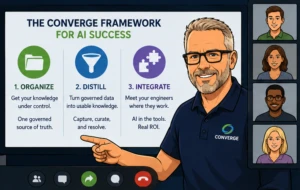
Integrate: meet your engineers where they work
Finally, the AI has to reach your team inside the tools they already use. We integrate the right ones, whether Claude, Gemini, GPT, Notion, or the AI built into SOLIDWORKS, into the workflows your engineers touch every day. Engineers forget the AI that lives in a separate tab. AI that answers questions inside your engineering process, grounded in the data you organized and distilled, returns real, measurable time to your team. That is where ROI stops being a line on a slide and starts showing up in the week.
Start with governed data, not the hype
None of this requires ripping out what you own or betting the company on a moonshot. It is methodical work applied to your information, in the right order. Organize before you distill. Distill before you integrate. Skip a step and you get exactly the confident, wrong AI that gives the whole category a bad name.
That order is also why the teams moving fastest on AI are usually the ones with mature data management already in place. If you already govern your design data, you have done more of the hard part than you think. If you do not, that is where to start, and it pays off with or without AI.
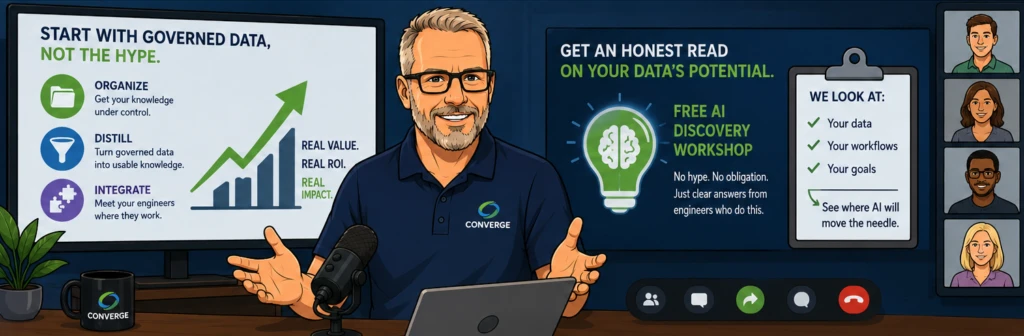
Wherever you land, the first move is the same: get an honest read on what your data can support today. Converge runs a free AI Discovery Workshop to do exactly that. We look at your data, your workflows, and your goals, then show you where AI will actually move the needle and what has to be true first. No hype, no obligation, just a clear picture from engineers who do this work.