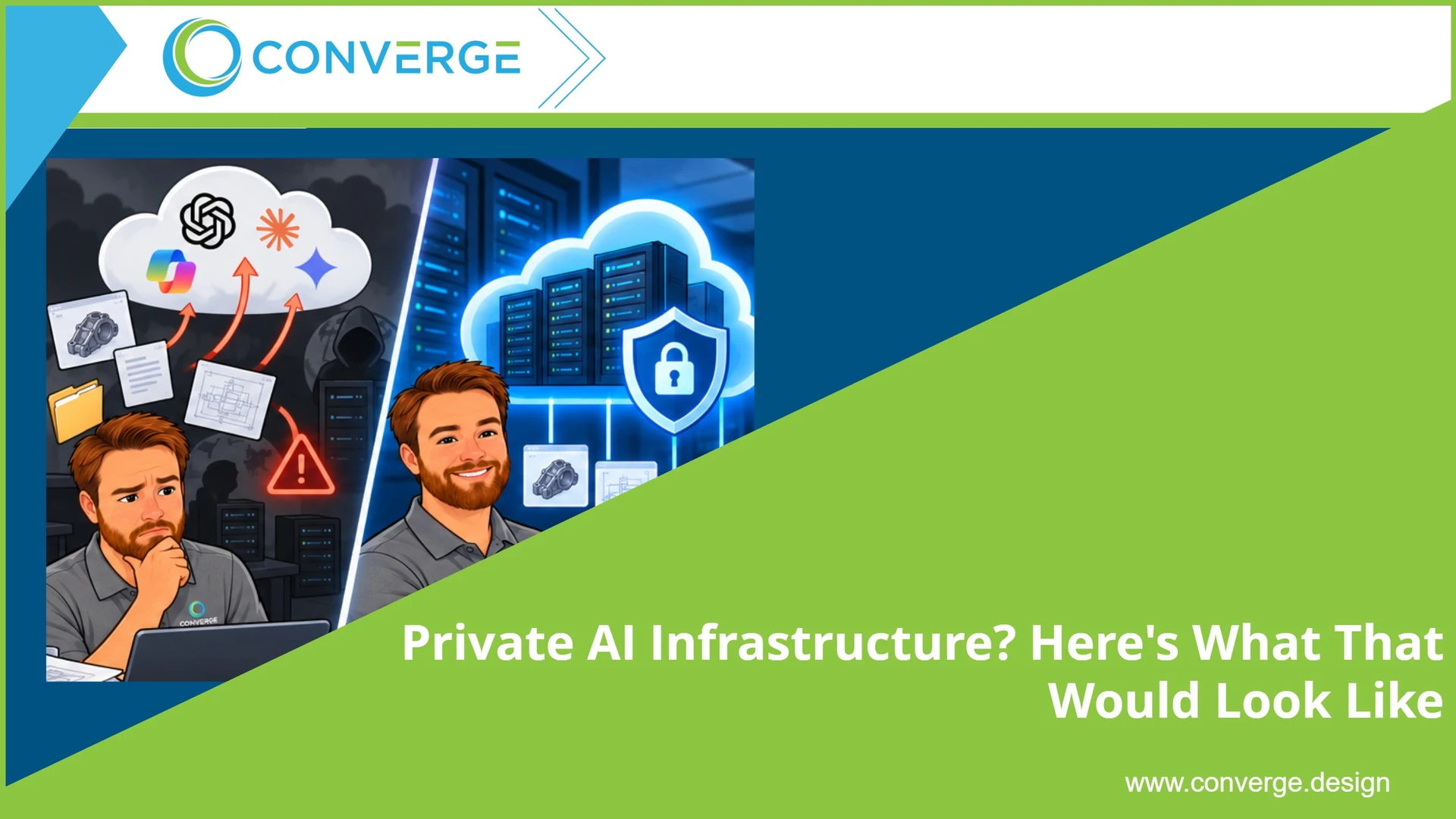
Your engineers are already using AI. Someone pasted a supplier spec into a chatbot to summarize it. Someone else uploaded a customer's drawing package to ask about a tolerance stack. Useful, and every one of those prompts left your network. 
That is the part worth slowing down on. When proprietary engineering data goes to a public AI provider, you are trusting someone else's infrastructure, retention policy, and terms of service with your intellectual property. Depending on the plan, prompts may be logged, retained, or reviewed, and some consumer tiers use them to improve future models. Even enterprise plans with strong contractual protections still put your data outside the systems you govern. If you work under customer NDAs, export controls, or industry regulations, it can mean a compliance problem you discover after the fact.
Banning AI is not the answer. Bans push usage onto personal accounts, where you have even less visibility. The better answer is to bring AI to your data with private AI infrastructure instead of sending your data out.
The alternative: private AI infrastructure
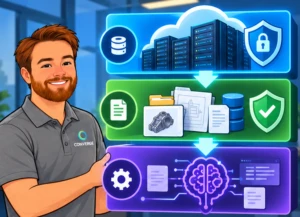
A private AI stack runs a large language model (LLM) on infrastructure you control, under the same rules that govern the rest of your engineering data. Prompts, documents, and answers stay inside that boundary. You still get summarization, search across years of project knowledge, drafting, and answers to engineering questions, without handing your IP to a third party. In plain terms, the stack has three layers.
Layer 1: Hosted compute
LLMs need serious GPU horsepower, and most engineering firms have no interest in buying, cooling, and maintaining racks of it. Managed hosting solves that. EpiGrid has hosted SOLIDWORKS and PDM (Product Data Management) environments for engineers and manufacturers since 2011, with SOC 2 and HIPAA compliance and Secure Enclave options for stricter requirements. The principles that make hosted CAD secure apply directly to hosted AI: dedicated and isolated resources, continuous monitoring, and encrypted site to site connections back to your network.
Layer 2: Governed data
A private model is only as good as what it reads. Point it at scattered drives full of superseded specs and you get confident, wrong answers that just happen to stay private. That is why Converge builds AI on a framework we call Organize, Distill, Integrate. Organize puts your design data under one governed source of truth, usually a managed PDM vault with controlled versions, revisions, and access. Distill turns that data into usable knowledge by retiring outdated documents, capturing the processes your senior engineers carry in their heads, and deciding which source wins when two disagree. Integrate connects the result to the tools your team already uses, with permissions carried through. The AI should never show someone a document they could not open in PDM.
Layer 3: The private model layer
This is the model itself. A private LLM gives you the same capability as the public tools, on hardware you control. Capable open weight models now run well on private hardware, so you can choose one sized to the job rather than paying for the largest model available. A retrieval layer connects the model to your governed knowledge base, so it answers from your documents and cites them instead of guessing. You control which model version runs, who can query it, and what gets logged. No vendor retrains anything on your data, because no vendor ever sees it.
Is private the right call for you? 
Not every team needs it. For general writing and research, a public enterprise tool with the right contract terms may be perfectly reasonable. Private infrastructure makes sense when your data is your competitive edge, when customer contracts restrict where their data can go, or when you operate in a regulated industry. Many teams land on a hybrid, with private AI reserved for design data and customer files. The tradeoff is ownership. Private AI means someone has to plan capacity, update models, and keep the environment healthy, whether that is your IT team or a partner.
Start with an honest read on where you stand
The right answer depends on your data, your contracts, and how your team actually works. Converge offers an AI Readiness Assessment to sort that out. We look at where your engineering data lives today, what your compliance obligations require, and whether a private, hybrid, or public approach fits, including hosting options if private wins. No hype, no obligation, just a clear picture from engineers who do this work.
Schedule your AI Readiness Assessment and find out what private AI would look like for your team.