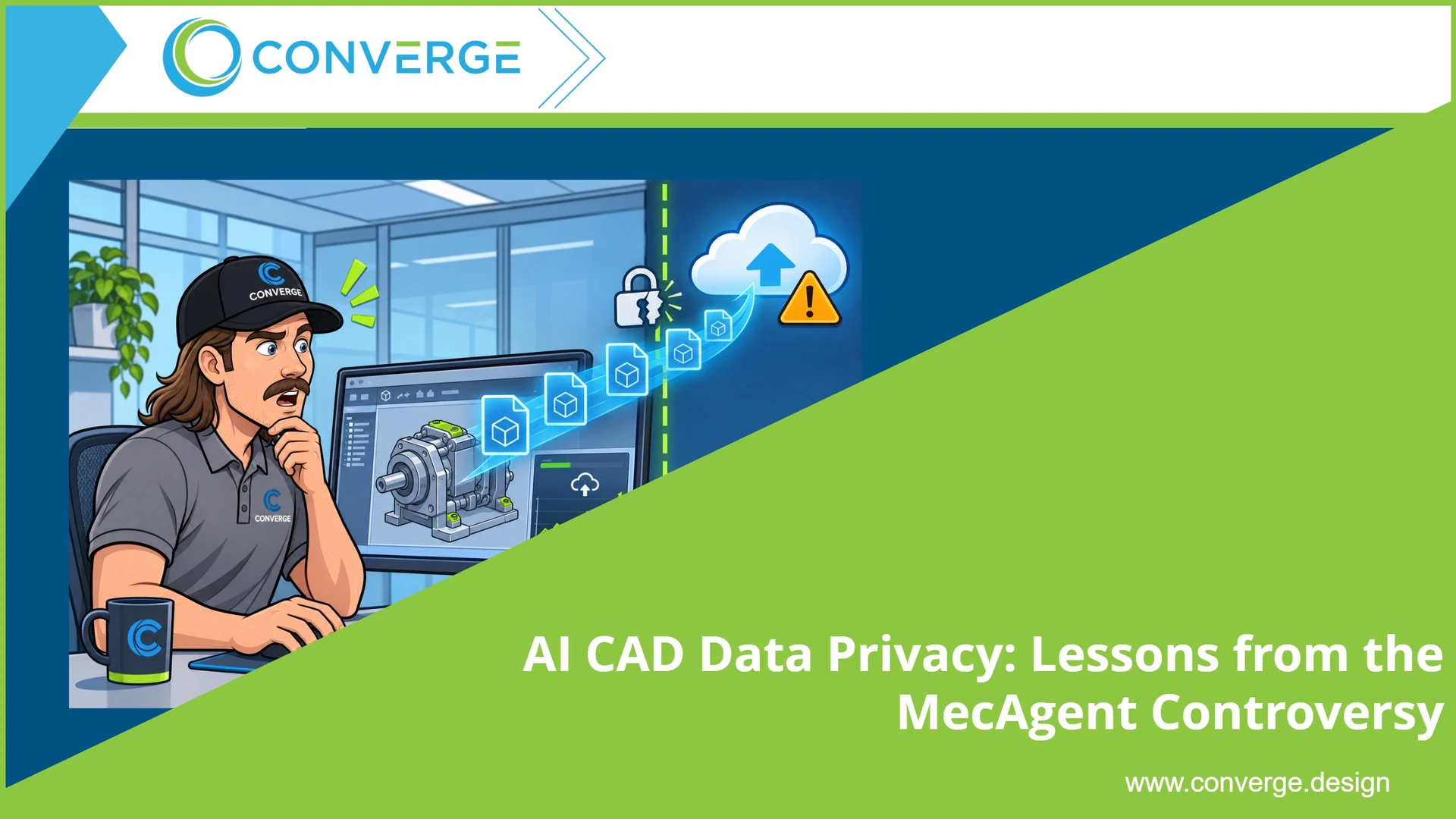
AI CAD Data Privacy: Lessons from the MecAgent Controversy
AI in CAD is moving fast, and much of it deserves the excitement. Agents can now build sketches from a sentence, automate repetitive features and answer modeling questions inside SOLIDWORKS. For busy engineering teams, that is a real step forward.
Last week, however, a bandwidth spike showed the other side of that promise. One SOLIDWORKS user wanted to know why an AI chat tool used so much network traffic. What they reported finding turned into a community-wide PSA. It also became a useful lesson in AI CAD data privacy for every engineering team, no matter which tools you use.
What happened
MecAgent is an AI agent for SOLIDWORKS that people often call a "Cursor for CAD." Three French engineers based in San Francisco launched it in 2025. Today, the company reports more than 35,000 installs.
In late October 2026, a Reddit user posted a PSA in r/SolidWorks. According to the post, the software scanned users' drives for CAD files and uploaded them in the background. The user said they spotted this while looking into why the AI chat used so much bandwidth.
MecAgent responded publicly. A company representative said paid plans don't collect data. The representative added that free-tier collection was meant for possible future model training, which had not started. The company also said it paused free-plan data collection until it clarifies its terms. In addition, as reported by industry coverage, it turned off free-plan signups as of October 30, 2026.
Our goal isn't to judge one vendor's choices. Instead, we want to look at what this moment teaches the rest of us.
Why AI CAD data privacy matters beyond one vendor
Engineering data isn't ordinary business data. A single assembly can hold years of design work, and it often belongs to more than one party.
CAD files are trade secrets. Your models, drawings and BOMs show how you solve problems your competitors haven't solved yet. That knowledge sits at the core of your company's value. Once it leaves your control, someone else can copy it.
Much of it belongs to your customers. Contract manufacturers and design firms often hold files under an NDA or supply agreement. As a result, you may not have the right to send that data anywhere.
Some of it is export-controlled. If you work with ITAR or CUI data, where you process and store files is a compliance question. It's not a matter of preference.
Two patterns behind SOLIDWORKS AI plugin security
First, free and freemium tiers often trade data for access. Plenty of software works this way, and it isn't wrong in itself. Still, it means a tool's free version can carry very different terms than its paid plan.
Second, a local agent with file-system access can reach more than the part you have open. Once a plugin runs on a workstation, its permissions and terms set the limits of what it can see. The window you happen to have open doesn't.
That's why SOLIDWORKS AI plugin security depends on two things: what the tool can touch and what its terms allow.
The real risk is shadow AI
Most engineers who install a free AI plugin are doing exactly what you hired them to do. They want a faster way to get work done. Nobody is trying to leak IP.
Even so, this is how shadow AI starts. Someone installs a plugin on a Tuesday to save twenty minutes on a drawing. Then a colleague adds it too. Meanwhile, IT never reviewed it, leadership doesn't know it exists and nobody read the terms.
So ask yourself a simple question. Could you list every AI tool that touches your PDM vault or your engineers' local drives today? For most small and mid-sized firms, the honest answer is no. That isn't a failure of discipline. Rather, it's a gap in visibility, and you can close it.
Checklist: read the fine print before you install
Before any AI tool lands on a workstation with engineering data, get clear answers to these questions:
- Training: Does the vendor use my data to train models? Do free and paid tiers get different terms?
- Local access: What can the tool reach on my machine: the open file, a folder or whole drives?
- Processing and storage: Where does my data go, and who can access it?
- Control: Can I opt out, delete my data and audit what the tool sent?
- Enforceability: Do these terms live in a contract, or only in a policy the vendor can change?
Of these, the last question matters most. A vendor can update a privacy policy at any time. A signed agreement, on the other hand, is a commitment. If a vendor's protections only live on a policy page, you're trusting that page to stay the same.
A better path: private AI hosting for engineering
None of this means engineering teams should sit out AI. Rather, AI should run where your data already lives, under terms you can enforce.
For that reason, EpiGrid built privately hosted AI infrastructure, launching January 1, 2027. It builds on the same certified, private hosting approach we use for SOLIDWORKS and PDM today. Here is what we commit to:
Complete data sovereignty. You own and control all data that moves in and out of EpiGrid's privately hosted AI infrastructure.
No model training on your data. EpiGrid will never use customer data to train any model.
No scraping. EpiGrid will never pull extra data from your local PCs or servers.
In writing. We put these commitments in the hosting agreement every EpiGrid customer signs. In other words, they're contract terms, not a policy we can quietly change. That answers the last question on the checklist.
Right now, we're onboarding a small group of engineering teams ahead of launch. Accepting customers for our pilot program.
One question to take back to your team
AI CAD tools will keep getting better. The teams that adopt them well will move faster, and good adoption starts with knowing where your data goes.
Here's the question worth asking this week: How confident are you that your team isn't sharing sensitive IP on public AI platforms?
If your answer is "not very," join the EpiGrid AI pilot program. Put AI to work on infrastructure you control.