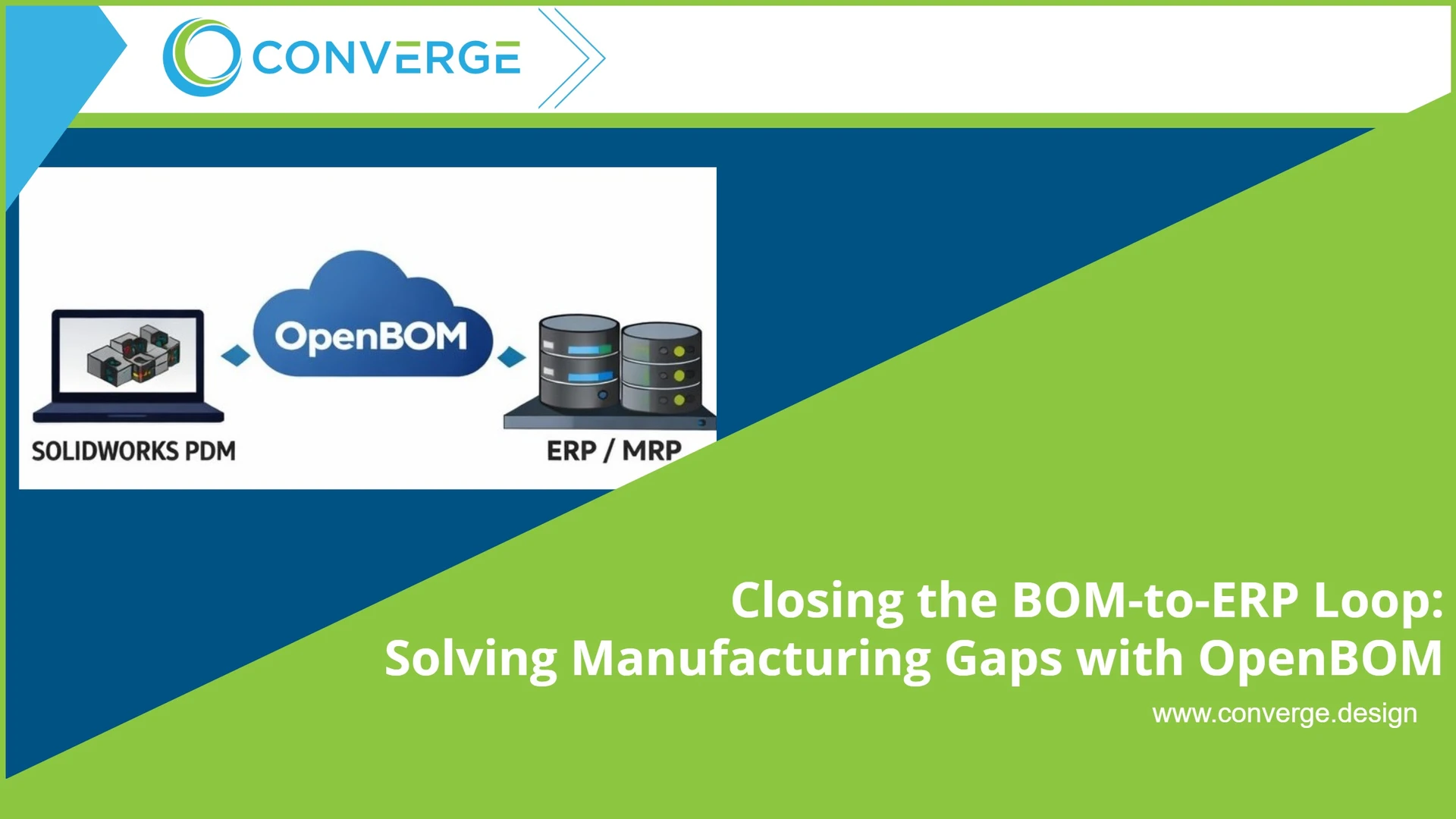
Why BOM-to-ERP Integration Is Still a Bottleneck for Engineering Teams
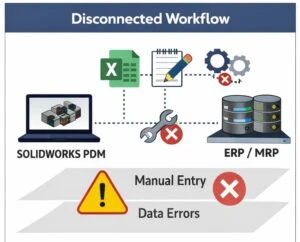 For many engineering teams, the challenge is not creating a bill of materials. It is getting BOM data and SOLIDWORKS metadata out of PDM and into ERP or MRP accurately, consistently, and without manual cleanup.
On paper, the workflow sounds simple. Engineering manages files and revisions in SOLIDWORKS PDM, then operations uses that data for planning, purchasing, and production. In reality, many organizations still rely on spreadsheets, duplicate data entry, or custom workarounds to move information downstream. That creates delays, introduces errors, and makes it harder to trust the data once it leaves engineering.
When part numbers, revisions, quantities, or custom properties do not transfer cleanly, the impact reaches far beyond CAD. Purchasing can order the wrong items. Manufacturing can build from outdated information. Service teams can struggle to identify the right configuration in the field. Converge planning materials identify this as a core challenge around BOM accuracy and ERP handoff, especially for manufacturers managing multiple product lines and service-part complexity . Related roadmap work also highlights the need to streamline BOM handoff and create a digital thread from CAD to BOM to MRP to ERP .
That is where OpenBOM stands out.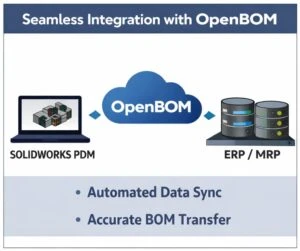
OpenBOM offers an out-of-the-box way for organizations of all sizes to structure BOM data, capture key metadata, and connect engineering information to downstream business systems without starting with a costly custom integration project. Converge internal planning also positions OpenBOM as a practical solution for BOM extraction and integration into MRP and ERP workflows .
Looking to close the gap between SOLIDWORKS PDM and your ERP/MRP system? Converge can help you evaluate the right workflow and implement a practical path forward with OpenBOM.