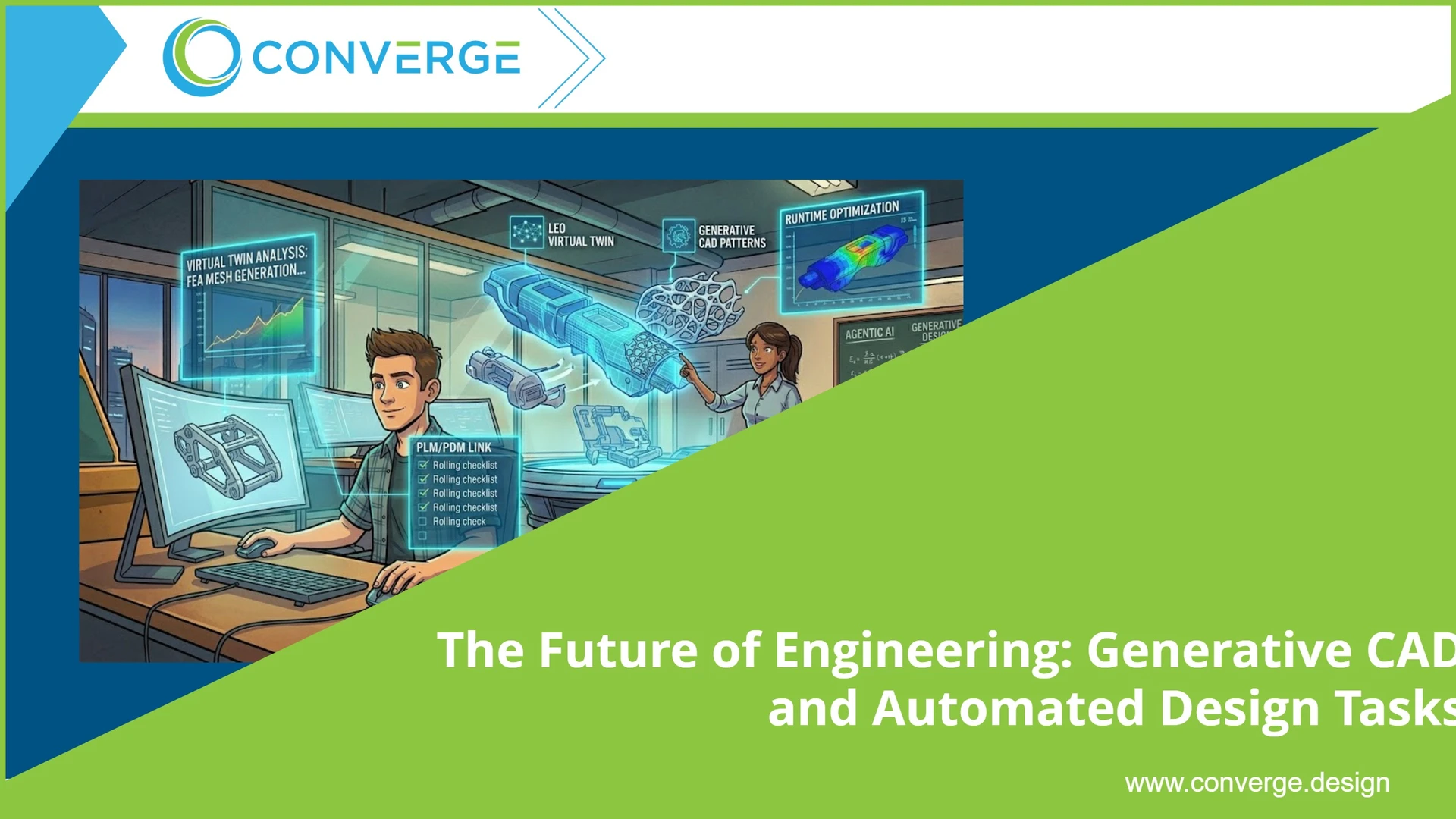
Picture a familiar engineering bottleneck: a tight deadline, an upcoming design review, and a critical component that just failed a late-stage finite element analysis (FEA). Shaving 15% off the part's weight traditionally meant a grueling, manual cycle of modifying geometry, rebuilding features, and re-running simulations.
Today, a paradigm shift is underway. By combining generative CAD with virtual twin architectures, engineering teams can escape this endless trial-and-error loop. Rather than manually drawing every line, engineers are shifting to defining functional intent—and leaving the tedious computational heavy lifting to AI-driven virtual companions.
What is Leo and the Virtual Twin?
At the forefront of this transformation is Leo, an AI-powered virtual companion natively integrated into Dassault Systèmes’ SOLIDWORKS and the 3DEXPERIENCE platform. Unveiled as a cornerstone of the platform’s agentic engineering ecosystem, Leo acts as a specialized virtual twin assistant. While a traditional digital twin merely mirrors a physical part's dimensions, a virtual twin captures its entire behavioral lifecycle, engineering constraints, and operational context.
Leo functions directly inside the SOLIDWORKS CAD environment, pulling from legacy Product Data Management (PDM) and Product Lifecycle Management (PLM) repositories. Instead of acting as a disconnected chatbot, Leo continuously analyzes your FeatureManager design tree. It understands context, references organizational design history, and captures tribal knowledge—such as proprietary tolerance standards or historical material successes—ensuring that generative guidance is grounded in corporate reality rather than generic web data.
How Generative CAD & Automation Change Engineering Work
The integration of Leo into day-to-day engineering fundamentally alters the product development workflow by embedding simulation-in-the-loop and automated validation directly into the modeling phase.
- Prompt-Based Generative CAD: Engineers can use natural language prompts to establish structural requirements. Leo can automatically generate foundational assembly structures, map component hierarchies, and even assist in 2D-to-3D mesh conversions from conceptual sketches.
- Context-Aware Feasibility: As design geometry progresses, Leo performs continuous, real-time manufacturability checking. If an engineer models an undercut that requires impossible tooling or specifies a tolerance that exceeds local machining capabilities, Leo flags the conflict immediately.
- Automated Troubleshooting & Updates: When a complex assembly suffers from broken mates or FeatureManager errors, Leo runs a root-cause analysis and guides the user through step-by-step resolution. Once geometry is finalized, repeatable automation of design patterns takes over, automatically generating detailed engineering drawings with appropriate templates, scales, and Bills of Materials (BOM).
This continuous validation drastically compresses design cycles. It shifts simulation from a late-stage validation gate to an active, run-time optimization tool, allowing small-to-medium firms to iterate faster with high confidence in final manufacturability.
Other Generative Design Options
While Leo provides a deeply integrated virtual-twin experience for SOLIDWORKS users, alternative generative tools offer specialized strengths that technical decision-makers should evaluate:
- Autodesk Generative Design (Fusion 360): Renowned for its cloud-driven topology exploration, it simultaneously generates dozens of manufacturing-aware outcomes based on cost, material, and production methods.
- nTopology: Focuses heavily on implicit modeling, excelling at complex lattice structures and advanced manufacturing workflows (like additive manufacturing) that traditional CAD tools struggle to compute.
- Ansys Discovery: Provides rapid, physics-driven optimization, offering instantaneous live physics simulation directly during the geometry modeling phase.
- PTC Creo Generative Extensions: Delivers high-fidelity, physics-informed generative design fully embedded within the parametric environment, maximizing enterprise PLM alignment.
Conclusion & CTA
 The pairing of generative CAD with intelligent virtual twins like Leo transitions engineering teams from drawing lines to managing design intent. To see how these tools can accelerate your product development, contact our team to schedule a technical brief or a live SOLIDWORKS simulation demo today.