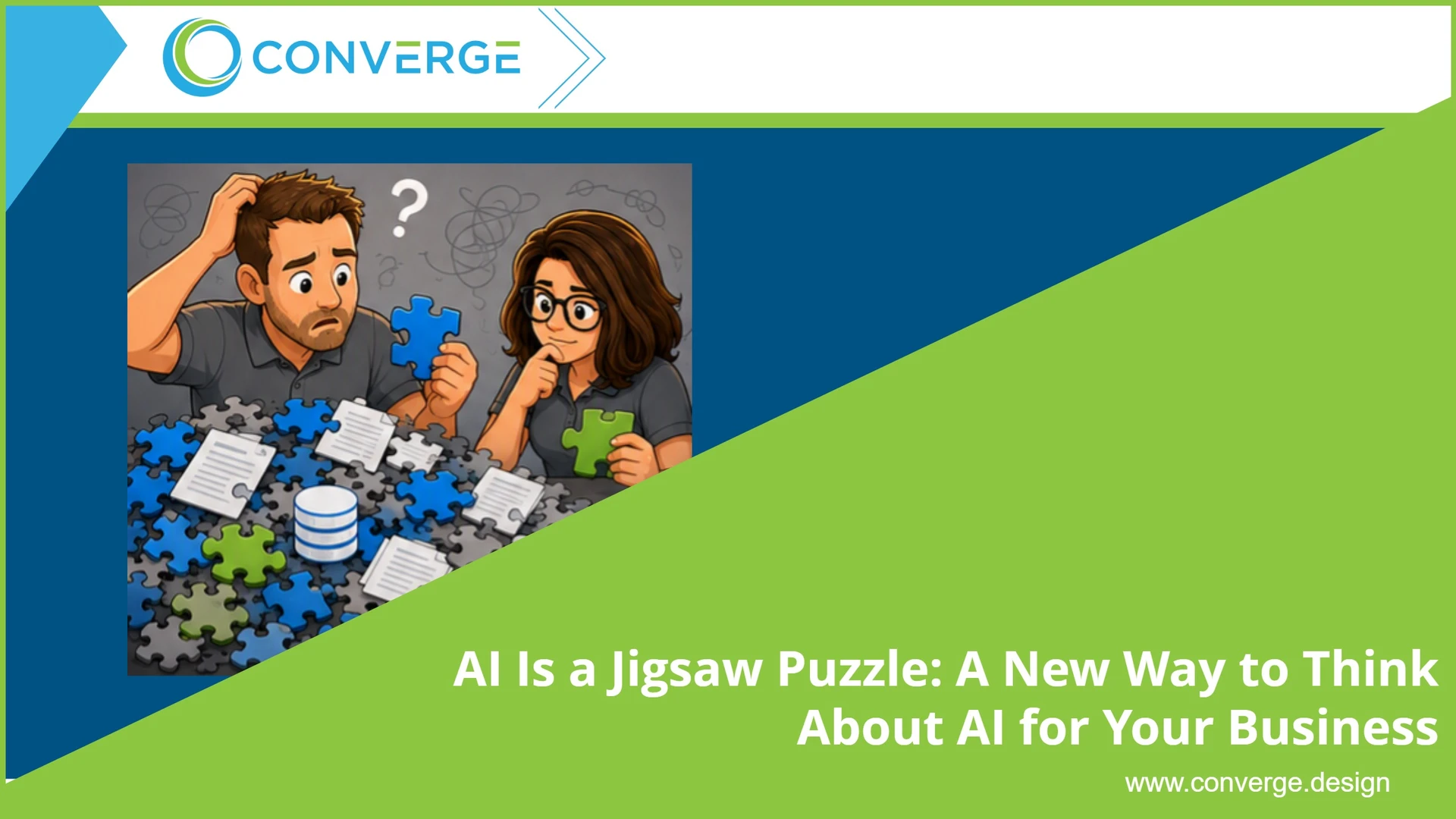
Most companies approach AI the way an impatient kid approaches a 1,000-piece puzzle: dump the box out, grab two random pieces, and try to force them together. When they don't snap, they conclude the puzzle is broken. It isn't. They just started in the wrong place.
Anyone who has actually finished a jigsaw puzzle knows the move. You don't start in the middle — you find the edges first, build the frame, sort the pieces into groups, and only then start filling in the picture. AI works the same way. The organizations getting real value from it aren't the ones with the flashiest model — they're the ones who built the frame before forcing pieces together.
At Converge, we use a simple framework to get there: Organize → Distill → Integrate.
Start With the Edges: Organize

The edge pieces are your governed data — the clean, structured, trustworthy information that defines the boundaries of what AI can do for you. Skip this and every later step wobbles, because a model is only as good as the data you let it touch.
Take financial services. A wealth management firm wants an AI assistant that answers advisor questions about client portfolios. If client records, compliance rules, and transaction histories live in twelve disconnected systems with inconsistent naming, the AI will confidently hallucinate. Build the edges first — a governed, permissioned data layer with clear access controls — and the same AI becomes an asset the compliance team will actually sign off on.
The edges aren't glamorous. Nobody brags about data governance at a dinner party. But every finished puzzle starts there.
Sort the Pieces: Distill
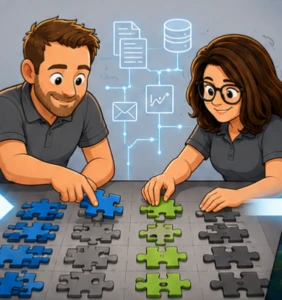
Once the frame exists, you sort. You don't try to place all 1,000 pieces at once — you group them by color and pattern. Distilling means turning your raw organized data into something AI can reason over: the key documents, the institutional knowledge, the patterns that actually matter, separated from the noise.
Consider life sciences. A pharmaceutical team sits on decades of trial data, regulatory filings, and research notes. The raw pile is overwhelming. Distillation is the work of identifying which pieces belong to which part of the picture — which protocols inform safety, which findings inform efficacy — so that when a researcher asks a question, the AI is reasoning over the right subset, not the entire warehouse. This is where a vague "we have a lot of data" becomes a usable knowledge base.
Build the Picture: Integrate
Now you place pieces into the frame, and the image emerges. Integration is where AI stops being a side experiment and becomes part of how work actually happens — embedded in the tools your team already uses, triggering the workflows that already exist.
 Construction makes this concrete. A general contractor doesn't need a chatbot in a separate browser tab. They need AI that reads the incoming RFI, cross-references the governed project drawings (the edges), pulls the relevant spec sections (the distilled pieces), and drafts a response inside the project management system the team already lives in. Integrated into the workflow, AI saves hours per week. Bolted on the side, it collects dust by Thursday.
That's the whole picture coming together — not because the model got smarter, but because you placed the pieces in order.
Why Order Matters
The reason most AI initiatives stall is that companies start with Integrate. They buy a tool and try to wire it into everything before they've governed or distilled the data. It's forcing center pieces together with no frame to hold them. The pieces don't lock, the picture never forms, and the whole thing earns a reputation as hype.
Organize → Distill → Integrate is just the discipline of doing a puzzle properly. Edges first. Sort second. Picture last. It's not flashy, but it's the difference between a finished image and a box of loose pieces.
See Your Own Picture
You already have the pieces — your data, your knowledge, your workflows. The question is whether they're sorted or still in the box.
We'll help you find your edges. Book a free 60-minute AI Discovery Workshop and we'll map your Organize → Distill → Integrate path together